Book Review: An Elementary Guide to Reliability

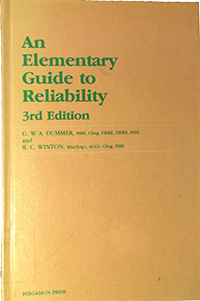
Cover of An Elementary Guide to ReliabilityBook Review: An Elementary Guide to Reliability

If you sort your Amazon search on ‘reliability engineering’ by price: low to high, you may find some interesting titles available for free or maybe a few pennies. Not one to resist a chance to fill another bookcase, it’s been a bit of spending spree.

One of the reasons, I am interested in older titles is to determine why MTBF is so prevalent today. So far, still looking and learning along the way.

There are many great books in our field. Sure, some are older. Some are not at all useful or helpful.

This book review is the first in what may become a monthly addition to the NoMTBF blog.

Today’s review is on the book, An Elementary Guide to Reliability (3rd) Third Edition, by G. W. A. Dummer and R. C. Winton. Continue reading Book Review: An Elementary Guide to Reliability

When Do Failures Count?

14586657179_3359d879f8_m_dWhen Do Failures Count?

One technique to calculate a product’s MTBF is to count the number of failures and divide into the tally of operating time.

You already know, kind reader, that using MTBF has its own perils, yet it is done. We do not have to look very far to see someone estimating or calculating MTBF, as if it was a useful representation of reliability… alas, I digress.

Counting failures would appear to be an easy task. It apparently is not. Continue reading When Do Failures Count?

Illuminating MTBF’s Lack of Information
14586612669_cc57c310e0_m_dIlluminating MTBF’s Lack of Information

Here’s a simple illustration of how MTBF oversimplifies data concealing essential information.

By convention, we tend to use MTBF for repairable data. That is fine.

You may also be aware of my dislike for the use of MTBF, for many different reasons. If you find yourself suggesting your organization, customer, industry or whomever to stop using MTBF, you may want to use this simple example to illustrate the ‘value’ of MTBF. Continue reading Illuminating MTBF’s Lack of Information

MTBF Search Result Sadness

Equipment that didn't advertise with MTBFA Quick MTBF Search Reveals Distressing Results
I was preparing to write this article and wondered how many search hits would appear for MTBF? So, opened Google and did an MTBF search. It is a common if misunderstood, acronym.

Beyond the 5,200,000 Google search results, it was the first page results that got me thinking. Keep in mind that Google often serves up a combination of what it thinks you are seeking and which sites have been useful for others.

Let’s break down what you find when you do an MTBF search. Continue reading MTBF Search Result Sadness

4 Questions to Ask When Confronted with MTBF
14805045513_43a0509d1b_z4 Questions to Ask When Confronted with MTBF

MTBF comes up a bit too often. When it does I have found rolling my eyes and arguing against using MTBF is not very effective.

So, what should a knowing reliability professional do instead?

Let’s explore four questions that you can ask that may help others find the value in no longer talking about MTBF. Continue reading 4 Questions to Ask When Confronted with MTBF

Replace After MTTF Time To Avoid Failures – Right?

MTTF and maintenanceReplace After MTTF Time To Avoid Failures – Right?

Received a short question last week. The person writing seems to already know the answer, yet asked:

If we replace an item after a duration equal to the MTTF value, we would avoid failures, right?

Well, no, most likely not, was my response. What is your response? How would you answer this question? Continue reading Replace After MTTF Time To Avoid Failures – Right?

Another Way to Spot Someone Confusing MTBF

Vintage machine image, without confusing MTBFYet Another Way to Misunderstand MTBF

In a Q&A forum, the response to a question concerning failure rate and repair times for a redundant system demonstrated yet another person confusing MTBF with something it is not.

The responder to the question mentioned the reference to repair time implied the need for MTBF as a metric. Then went on to describe MTBF as the duration of repair time, which should not change given a redundant system over a non-redundant system. Continue reading Another Way to Spot Someone Confusing MTBF

3 Ways to Improve your Reliability Program

The reliability performance of equipment is a reflection of your reliability programA Few Simple Ideas to Improve Your Reliability Program

Spending too much on reliability and not getting the results you expect? Just getting started and not sure where to focus your reliability  program? Or, just looking for ways to improve your program?

There is not one way to build an effective reliability program. The variations in industries, expectations, technology, and the many constraints, shape each program. Here are three suggestions you can apply to any program at any time. These are not quick fix solutions, nor will you see immediate results, yet each will significantly improve your reliability program and help you achieve the results you and your customers expect. Continue reading 3 Ways to Improve your Reliability Program