A friend and colleague brought a thesis paper by Louis J Hogge to my attention. Titled “Effective Measurement of Reliability of Repairable USAF Systems, the document proceeds to recommend the US Air Force to stop using MTBF and related measures and instead to use Mean Cumulative Functions (MCF) instead. Continue reading USAF and MTBF
MTBF Alternative
There are Alternatives to using MTBFJust a quick note this week to pass along a message from Michael. He’s conducted a bit of research on Mean Cumulative Function and found a few papers. And, according to Michael’s request I’m working on a short introductory tutorial for those new to MCF. Continue reading MTBF Alternative |
Ethics and MTBF
The Ethics of MTBF
The National Society of Professional Engineers (NSPE) has a code of ethics. As expected. Other professional groups also have similar code of ethics that provide guidance to their members and set expectations for everyone.
Bathtub Myth
A Question about the Bathtub Myth
Question:
Do all components follow the bathtub curve? Is it possible to generate a bathtub curve for a component?
Thanks for your thoughts and insights!
V.
Response:
This is a good question. Continue reading Bathtub Myth
Eliminating early life failures
Finding and eliminating early life failures
MTBF for electronics life entitlement measurements is a meaningless term. It says nothing about the distribution of failures or the cause of failures and is only valid for a constant failure rate, which almost never occurs in the real world. It is a term that should be eliminated along with reliability predictions of electronics systems with no moving parts. Continue reading Eliminating early life failures
NoMTBF Non-Users Group
Let’s Create a NoMTBF Non-User’s Group Today
We do it right!
Those that read this blog regularly know that I, along with many others, have some passion for the eradication of MTBF from common use. We make arguments, create examples, describe the errors and encourage using other methods. The campaign seems to be going along well. Yet MTBF is still in use – in standards, in certifications, and even taught by those that should really know better. We’re making progress, but there is much more yet to do. Continue reading NoMTBF Non-Users Group
Please don’t remove MTBF, part 2
Please don’t remove MTBF, part 2
This note is the second part of my response to a forum entry by HL concerning two arguments he is attempting to refute. Of course, my arguments for the eradication of MTBF may stir up some resistance. My plea to use a better approach may challenge the status quo or ruffle a few feathers. So be it. That is expected. Continue reading Please don’t remove MTBF, part 2
Please don’t remove MTBF part 1
Please don’t remove MTBF, part 1
A forum post recently correctly found two of my many arguments for the eradication of MTBF incorrect or invalid. Maybe the author (HL) has a valid point. Let’s take a closer look at the note and the writer’s reasoning. Continue reading Please don’t remove MTBF part 1
MTBF: What is it Good For?
MTBF: What is it Good For?
Guest post by Andrew Rowland, CRE, ReliaQual Associates, LLC
I. INTRODUCTION
The mean time between failure (MTBF) is arguably the most prolific metric in the field of reliability engineering. The MTBF is used as a metric throughout a product’s life-cycle; from requirements, to validation, to operational assessment. Unfortunately, MTBF alone doesn’t tell us too much. Continue reading MTBF: What is it Good For?
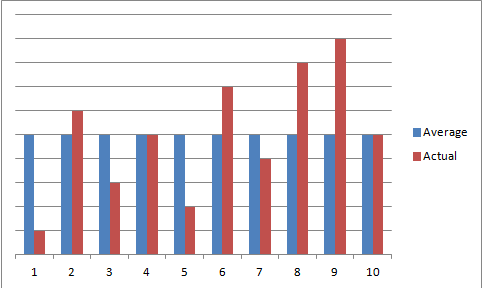
Where MTBF falls short
Where MTBF Falls Short
Guest post by Chris Peterson – see her daily blog Test To Be Your Best
I have a brand new widget and I’m very excited about the design. It has features I’ve never built in before, there is a huge market need for it, and now I have to try to prove it’s reliability before I can sell it. What do I use? Continue reading Where MTBF falls short

NoMTBF guest post Challenge
In the NoMTBF newsletter I’ve announced a contest for this site.
I’d like to invite you to write a guest post on MTBF, either good or bad, for or against, a case study or how-to-use article. Just something about MTBF.
Then, if during the week we post it the site reaches a new record for visits, I’ll send you a shiny new NoMTBF logo coffee mug. Continue reading NoMTBF guest post Challenge
MTBF Leadership
MTBF Leadership
MTBF is a common reliability metric. It is totally useless in most applications. So, why do we use it? And what can we do as reliability professionals to lead our industries away from using MTBF?
A recent set of forum discussions raised the idea that we use MTBF because our customers require it. Another writer suggested that MTBF is useful because it has been in use for so long, and therefore it must be useful. Another writer advertised their offer to determine MTBF for you for a small charge. Continue reading MTBF Leadership
Weibull vs Exponential PDFs
Comparison of Weibull vs Exponential PDFs
This is a short interactive note that let’s you play with different β values and compare the impact for a simple calculation. You may need to download and install the free Wolfram Player and plugin for your browser. You can find it at
<http://www.wolfram.com/cdf-player/
Value and MTBF
 Value and MTBF

The value of any task is in the result, although a few may argue about the value in the journey itself. For reliability engineering tasks, the ability to use the output of an experiment or analysis to make decisions permits an organization to derive value from the tasks. Despite a few organizations that insist on Continue reading Value and MTBF
Change from MTBF
If you want to make enemies, try to change something ~Woodrow Wilson
Change
Newton had it right, objects at rest tend to remain at rest, and objects in motion tend to stay in motion. We can say that both states resist changing into the other state unless some force acts on the object. You can feel this resistance when going around a corner in a car. You body seems to want to continue straight and it is the seat, belt buckle, door frame that conspire to bring you along with the car around the corner. Continue reading Change from MTBF